FatDyn-X

Durability software for FE analysts

FatDyn-X

Integrated Fatigue, Dynamics, & Crack-Growth Analysis

An inertia-relief / static or normal-modes run of your Nastran or OptiStruct model. One input deck. Fatigue life, dynamic response and crack growth under time-history and frequency-domain loads.

Inertia-relief / static or normal modesone solver run feeds fatigue, dynamics and crack growth
1 input deckfatigue, dynamics, welds and crack growth together
Time and frequencyload histories, frequency response and PSD loads
1 executablestand-alone on Windows, keyword deck or GUI

Introduction

The durability answer and the dynamics behind it, from the same run

A conventional durability process needs a fatigue tool, a separate transient solve for the dynamic events, and another tool again for cracks. FatDyn-X starts from the inertia-relief / static run you already have, or from a normal-modes run. Inertia-relief / static gives both fatigue and dynamics, and remains the method of choice for stiff structures and preliminary loads. With the normal modes, FatDyn-X solves the quasi-static and the modal-transient response itself, and adds the frequency domain. Fatigue life, weld life and crack growth then come out together with the node motions, element forces and mass forces that explain them.

What goes in

  • Normal modes, or inertia-relief / static unit load cases, from Nastran or OptiStruct (PCH, OP2, H3D)
  • Load-channel time histories (CSV, RSP), or load and acceleration PSDs
  • One keyword deck, written by hand or with the FatDyn-X Studio GUI

What comes out

  • Fatigue life of shells, solids, spot welds and seam welds
  • Displacement, velocity, acceleration, element-force and mass-force histories
  • Crack-growth life and inspection intervals at the critical sites
  • CSV tables and contour files for HyperView and other post-processors

Three main categories

Fatigue, dynamics and crack growth in one program

Special features

What sets FatDyn-X apart

Capabilities that are hard to find in one place, and that change how a durability job is set up.

All special features

Checked before release

Verified against tests, closed-form solutions and commercial FEA

77,100 cyclespredicted for a welded T-tube from a public test program; the twelve tested specimens averaged 75,000

Same lifefrom inertia-relief via normal modes as from the static inertia-relief solve, on plates and on a full truck frame

38 checksof the crack-growth laws and geometries against closed-form solutions, plus an end-to-end run within 0.01 %
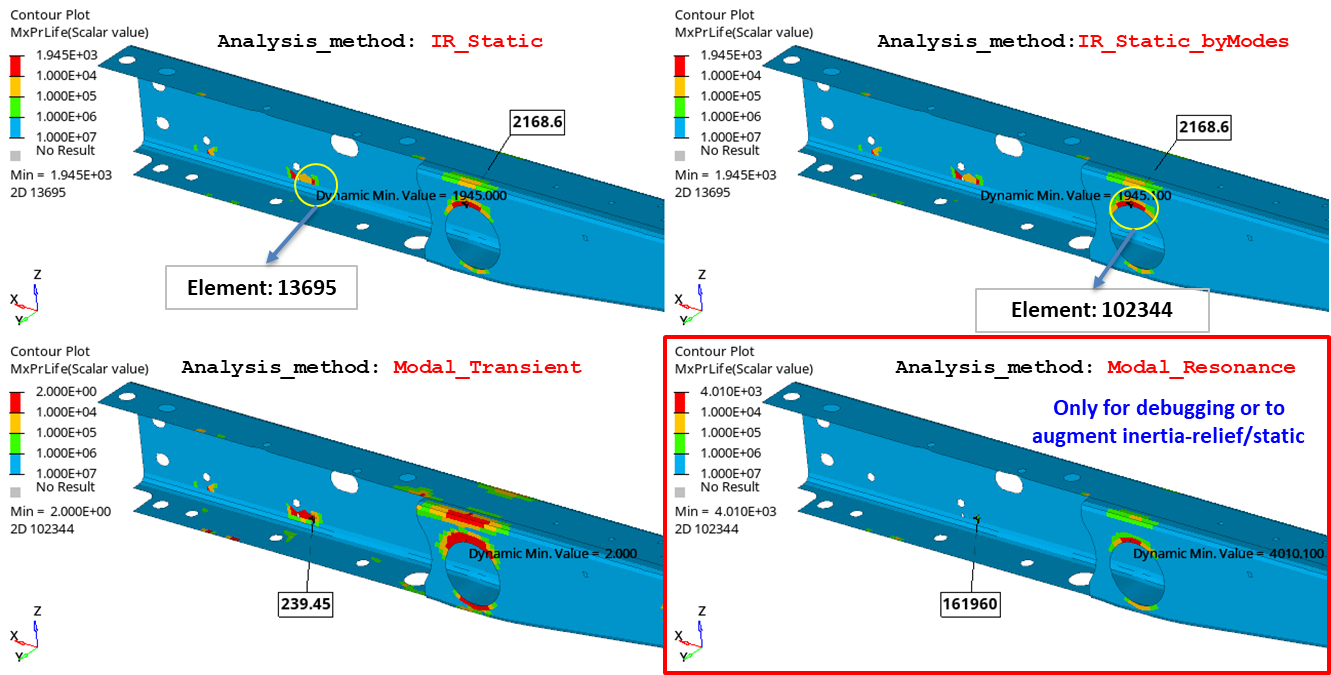
Fatigue life contours on a truck-frame rail from four analysis methods
Truck frame, four analysis methods in one run. The modal-transient solve moves the critical location and shortens the life, which a quasi-static analysis would not show.

See it on your own model

Send a note for a demonstration, the technical overview, or an evaluation licence. Partnership and reseller enquiries are welcome.

Design-Analysis Technologies LLC
Troy, Michigan, USA