Base metal, welds, brittle materials and random vibration share one deck, one material database and the same rainflow and Miner kernels. Several methods run side by side in a single pass.
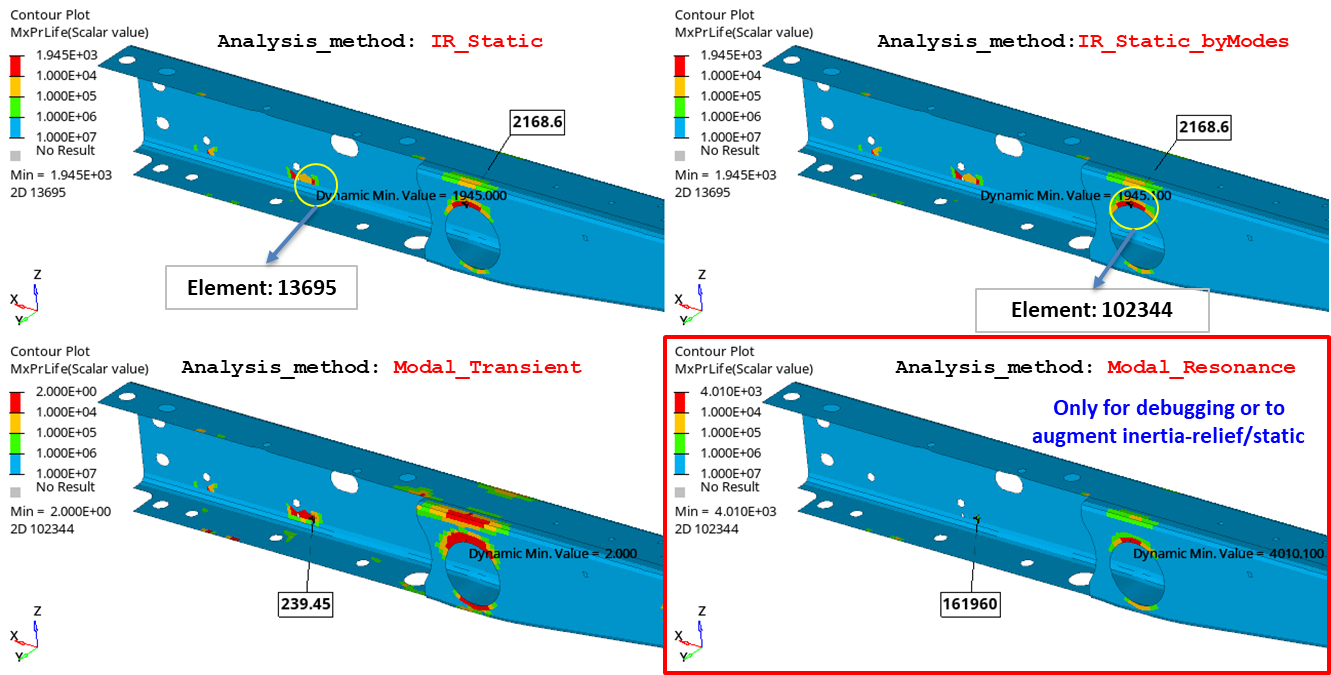
S-N and ε-N evaluations run in the same analysis, on shells and solids, with any of the solvers: inertia-relief, inertia-relief via normal modes and modal-transient.
Six mean-stress corrections
Goodman, Gerber, Walker or FKM for S-N; Morrow or SWT for ε-N. Neuber plasticity correction. Materials mapped by property id or material id.
Four stress methods at once
Absolute maximum principal, signed von Mises, Tresca and critical plane are evaluated together. No separate run per criterion.
Critical plane, shells and solids
Damage is evaluated on every candidate plane through a point. The worst plane, its normal vector and its life are reported. One algorithm covers shells and solids, which matters in thick cast, forged and 3D-printed sections.
Life contours on a truck-frame rail from four analysis methods in one run.
The open material database holds S-N, ε-N, brittle, crack-growth and weld cards. Every card carries its source.
Welds
Spot and seam weld fatigue
Weld life from grid-point force histories, for time-history and PSD loads, with every solver. One block in the deck defines the welds.
Spot welds
Rupp, Nakahara and Dong methods, side by side
CBAR, CBEAM, CBUSH, CWELD and ACM-hexa nuggets
2T and 3T stacks found automatically; each sheet and the nugget report their own damage
Damage at 36 angles around the nugget, worst angle reported
Crack-direction markers and the critical load channel per weld
Seam welds
Dong master-curve and Volvo two-curve methods, side by side
Toe elements found from the bulk data, both toes of a double fillet and the weld ends
Line forces along the toe give membrane and bending structural stress
77,100 cyclespredicted at the test crack site of a welded T-tube. The twelve tested specimens averaged 75,000 (29,000 to 190,000).
4000 lbf at R = −1. The toe stress is within 7 % of the published value, and the result holds on 8 mm and 16 mm meshes.
T-tube shell model and predicted life along the weld toe.
A 3T stack: damage on the shells of each sheet and on the crack-direction markers.
3T spot welds: damage on the sheets themselves
In a three-sheet stack the inner sheet carries the load transfer of both interfaces, and FatDyn-X reports it separately. Applied to an EV body with more than 5,000 spot welds and over a million time steps.
Duty cycles
Events solved by different solvers are summed into one damage map. The damage is summed per weld and per angle before the maximum is taken, so the crack direction belongs to the whole duty cycle.
Three events with the same load history and their duty-cycle sum. The modal-transient event carries about 90 % of the damage at the critical weld.
Frequency domain
Random vibration (PSD / ASD) fatigue
Normal modes plus a PSD give fatigue life. For load PSDs no frequency-response run in a commercial solver is needed, because FatDyn-X forms the transfer functions itself.
Dirlik spectral method
Spectral moments, RMS, irregularity factor and peak rate of the stress response, then Dirlik damage per element for shells and solids.
Load or base excitation
Load (force) PSDs go through the internal frequency response. Acceleration PSDs at the base use a solver deck that FatDyn-X writes for you.
Welds too
Spot and seam weld fatigue runs under PSD loads, for load PSDs and for base-excitation PSDs.
On the same model and loading, PSD fatigue finds the same hotspots as full time-history fatigue. To compress a duty cycle into one shaker test, see accelerated PSD tests.
Beyond ductile metals
Brittle materials and thermo-mechanical fatigue
Ceramics, glass, quartz
One material card carries two mechanisms: cyclic S-N with no endurance limit and tension-only damage, and slow crack growth from time at stress. Every constant is temperature-dependent.
Thermo-mechanical, direct transient
Stress and temperature histories straight from OptiStruct, Nastran or LS-DYNA thermal transients. Solids and shells, with S-N, ε-N and brittle materials mixed in one run.
Verification
Fatigue results against references
Case
FatDyn-X
Reference
Perforated plate, CQUAD4, S-N Gerber, life
1,026
1,026 (benchmark)
Perforated plate, CTRIA3, S-N Gerber, life
604
604 (benchmark)
Seam weld, welded T-tube, cycles at R = −1
77,100
75,000 (mean of 12 tests)
Spot weld, inertia-relief via modes, damage per repeat