FatDyn-X
Solver choices Fatigue + dynamics Event / mode classification Damage sensitivity Inertia-relief dynamics Any point and plane Accelerated PSD tests Bolted joints Studio GUI Fits your process

Solver strategy

Inertia-relief / static or normal modes: your choice per event

FatDyn-X works from an inertia-relief / static run (SOL 101) or from a normal-modes run (SOL 103). Inertia-relief / static remains important for stiff structures and when the loads are preliminary. When dynamics matter, a single normal-modes run gives the quasi-static and the modal-transient solutions, without the FORCE, TLOAD and TABLED decks of SOL 112.

Inertia relief / static

The established route: unit load cases from the solver, combined with the load histories. FatDyn-X adds node, element-force and mass-force histories to the fatigue result.

Inertia relief via normal modes

The quasi-static response is assembled from the modes. Loads are applied inside FatDyn-X, straight from the load-channel files.

Modal transient via normal modes

The same modes solved as a transient, with damping per mode, accurate from t = 0 with no start-up oscillation.

One modal stress for every event

A duty cycle that mixes quasi-static and dynamic events uses one set of modal stresses throughout.

Spot-weld check: damage per repeat of the same load history

SolverSolver result usedDamage per repeat
Inertia reliefStatic inertia-relief solve, one subcase per load channel1.08E-06
Inertia relief via modesThe normal-modes file only1.08E-06

Unified

Fatigue and dynamics together

Fatigue and dynamic results come from one input file, one executable and one solver result. There are no separate tools to keep in step and no results to stitch together.

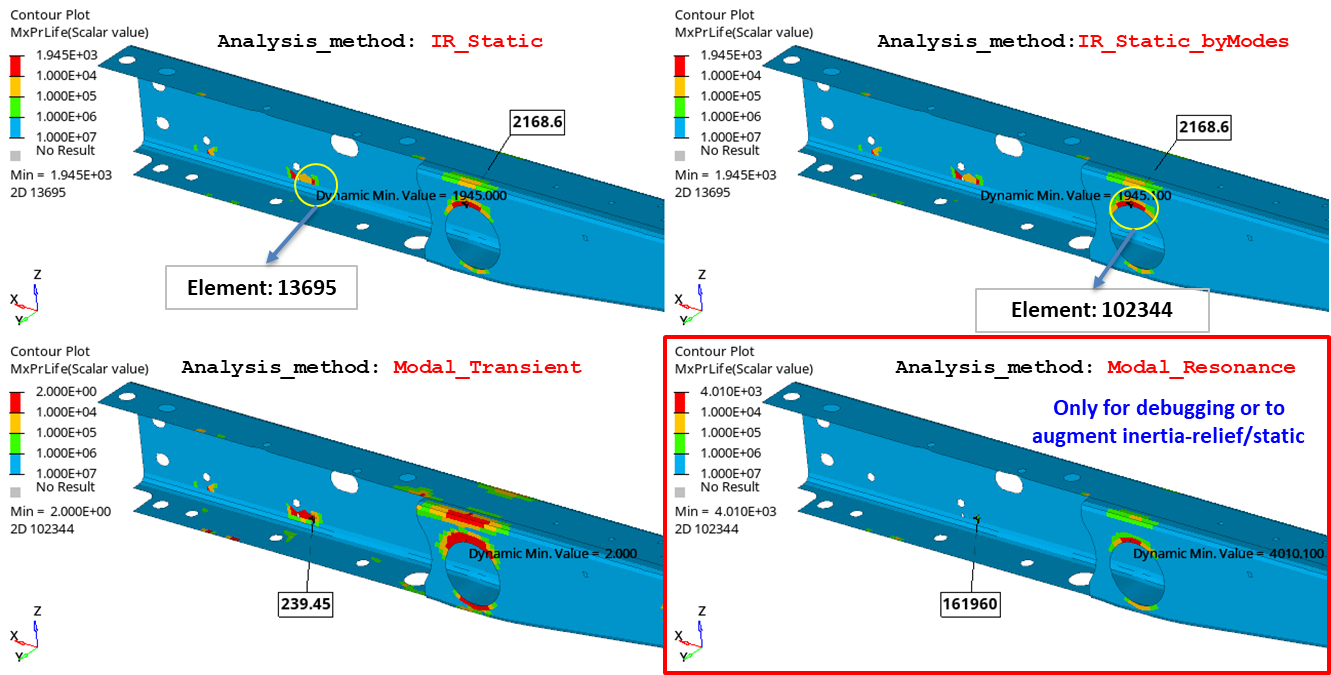
Example: truck frame, four analysis methods in one run

SolverWhat it showsMin life, location AMin life, location B
Inertia relief / staticBaseline1,9452,169
Inertia relief via modesSame answer from the modes alone1,9452,169
Modal transientEffect of the dynamics2402
Modal resonanceDiagnostic of dynamic amplification, mode by mode; not a life prediction by itself
Fatigue life contours on a truck-frame rail from four analysis methods
The modal-transient solve moves the critical location and shortens the life, which a quasi-static analysis would not show. The same load cases also write node accelerations, element forces and mass-force histories.

Screening

Static or dynamic? Event and mode classification by Time-PSD plots

A durability program holds many kinds of events: rough road, braking, jumps, parking, curb strikes. Some are quasi-static and others excite structural modes. Running dynamics on everything is expensive and can mislead. FatDyn-X classifies every event and every mode.

Ratio = PSD(fn) / PSDmax  ≥  threshold  ⇒  dynamic For each event and channel, time and PSD plots are built with a line at every natural frequency. If the PSD at any mode crosses the threshold, the event is flagged for a modal-transient solve; otherwise it is solved quasi-statically.

Event-level screening

Time histories and PSDs with natural-frequency overlays for every event and channel, and a summary that classifies each event.

Mode-level screening

Loads are projected to modal space, and the modal-load PSD tags each mode as modal-transient or inertia-relief via modes.

NVH modes and durability modes

Modes with a low ratio are solved quasi-statically, which prevents unrealistic resonance from modes that only matter for NVH.

Insight

Damage sensitivity to loads and modes

Which load channel and which mode drive the damage at an element or a weld? FatDyn-X ranks every channel and every mode, so design and test priorities follow the data.

Load-channel ranking

For each element: damage from the channel alone and damage without the channel. Output is contribution, importance and change in damage per channel.

Mode sensitivity

Mode-wise damage contribution per element. Shows the mode that drives the fatigue, and where damping or stiffening will pay.

Dynamic amplification

Ratio of dynamic to static modal-coordinate range at the chosen damping. A high value means a static analysis underestimates that mode.

Example: mode sensitivity and dynamic amplification at 10 % damping

ModeContribution %ImportanceDynamic rangeStatic rangeAmplification
73.690.99727.51417.04361.4 %
80.00-0.0035.3684.28525.3 %
210.0040.8000.6680.6680.0 %

Mode 7 is the dynamically dominant mode here; removing it drops the damage by 99.7 %. The same ranking is available per spot weld and per seam weld.

What's new

Inertia-relief / static now drives dynamics too

Traditional use of inertia-relief / static

Generally limited to stress and fatigue analysis. The full dynamic information sitting inside the inertia-relief run goes unused.

FatDyn-X enhancement

The same inertia-relief / static result plus the load histories give a full suite of dynamic calculations, in addition to stress and fatigue.

Dynamic calculations available from a single inertia-relief / static run

  • Node time histories: displacement, velocity, acceleration
  • Relative motion and strain between node pairs (contact, interference, twist, bending)
  • Spring, rod and beam force time histories
  • Shell and solid stress time histories
  • Acceleration including rigid-body motion
  • Mass-element force histories unique to FatDyn-X
  • Inertia-relief acceleration contours and mass forces unique to FatDyn-X

Mass-element forces size the mounts of EV battery packs, motors, payloads and avionics. The acceleration contours combine the inertia-relief accelerations with a trusted mass, inertia and CG, for example from the crash model or corner weights.

Fatigue

Fatigue at any XYZ point and plane

Give a point by element id or by XYZ coordinates with a plane normal. FatDyn-X finds the host element, transforms the normal and reports the life on that plane next to the absolute-maximum-principal life. Useful for weld lines, build planes of printed parts and postulated crack paths.

Testing

Accelerated fatigue tests with PSD loads

Electronics, battery packs, motors and engine components are proven on shaker tests. FatDyn-X combines the PSDs of many field events into a single test PSD, so days of duty cycle are compressed into a test of a few hours.

  1. Signals to PSDs

    Each event's acceleration or load history is converted to a PSD.

  2. One test PSD

    The event PSDs are combined, with their repeats, into a single PSD of the chosen test duration.

  3. Verification on the model

    FatDyn-X runs the duty cycle of the event PSDs and the single test PSD, and compares the damage.

Joint design

Bolted-joint slip design

Slip factor and margin of safety for every bolted joint, from the force histories of the CBAR / CBEAM bolt elements, with any of the solvers.

Creq(t) = Na · P+(t) + Ns · V(t) / (m · μ) Required clamp from the positive axial load P+ and the resultant shear V per bolt, with m friction interfaces, friction coefficient μ and safety factors Na and Ns. Slip factor = Ctarget / Creq; margin of safety = slip factor − 1.
  • Bolt diameters are read from the bulk data
  • Each diameter is mapped to a target clamp from a design table, M5 to M36
  • The required clamp is computed as a function of time
  • Slip factor and margin of safety are written as tables and contours

Applied on an EV program with about 1,000 bolted joints under long time-history loading.

Contour of the slip margin of safety on bolted joints
Contour of the slip margin of safety, used to choose bolt sizes.

Graphical front end

FatDyn-X Studio

Studio writes the input deck as you work through eleven steps, checks it before the run, starts the solver and the weld and crack-growth tools, and plots the results. The deck text can still be edited directly.

FatDyn-X Studio: the Events step with load channels on the left and the generated input deck on the right
The Events step: analysis method and load channels on the left, the generated deck on the right.
SetupModelSetsEventsFrequency & PSDFatigueWeldsCrack growthRunResultsStand-alone tools

Reads your model

Material and property ids, sets and mode frequencies come from the bulk data. Load channels are imported from CSV, and RSP files are converted.

Checks before it runs

Pre-flight checks list what is missing or inconsistent. Double-click a message to go to the step that needs fixing.

Materials with provenance

Tables and curve plots for S-N, ε-N, brittle, crack-growth and weld data, and a browser for the open material database.

Fits your process

Works with the solvers and tools you already use

Native result readers

PUNCH, OP2 and H3D results from Nastran and OptiStruct are read directly. Load channels come from CSV or RSP files, selected by column or by name.

Feeds other fatigue tools

Modal coordinates from one normal-modes run are written in PCH and CSV formats, for use in an established fatigue process.

Writes solver load cases

When a conventional solver run is still wanted, FatDyn-X writes the static, inertia-relief and transient load cases from the load histories.

Results are written as CSV tables and as contour files for HyperView and other post-processors. Parallel processing has no per-core fees.